Wedding Speeches in Ireland: Who Speaks, in What Order, and for How Long
Irish wedding speeches have a reputation, and it's earned. The best man who goes for twenty minutes. The father of the bride who thanks the caterers by name. The groom who forgets to mention his new wife until the last line. Everyone in the room has sat through at least one of these, which is exactly why a bit of planning pays off: the speeches are the part of the day guests talk about afterwards, and the part the wedding film returns to most.
This is how speeches usually run in Ireland, how long each should be, when to hold them, and the handful of things that make them sound as good on film as they did in the room.
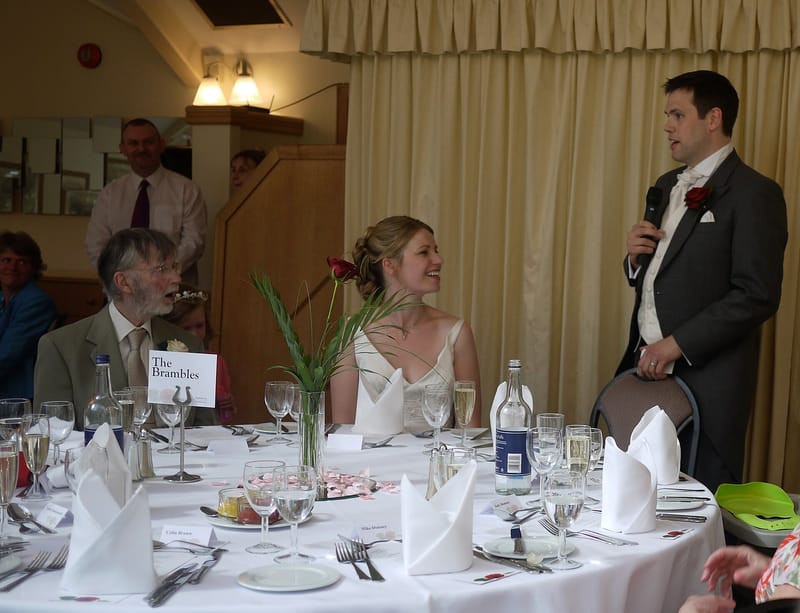
Photo: Phil Hawksworth, CC BY 2.0, via Wikimedia Commons
The usual order
There's no rule, but there is a habit, and most Irish weddings still follow it:
| Speech | Who | Usually covers | Length |
|---|---|---|---|
| 1 | Father of the bride (or whoever is giving her away) | Welcome, thanks to guests, a few words about his daughter, a welcome to the groom and his family | 5 to 7 minutes |
| 2 | Groom | Thanks to both families, the bridal party and suppliers, then his wife | 5 to 7 minutes |
| 3 | Best man | The groom, the stories, the toast | 5 to 7 minutes |
| 4 | Bride, maid of honour, or both | Increasingly common, and often the best of the day | 3 to 5 minutes |
Three or four speeches, 25 to 35 minutes in total, is the sweet spot. Six speeches at ten minutes each is an hour, and the room will have left you somewhere around minute forty.
Plenty of couples change the order, and more are doing it every year. Both parents speak, or neither does. Two grooms or two brides split the thanks between them. A sibling speaks instead of a best man. A friend reads something short. None of that needs explaining to anyone; put the order in writing for the MC and the speakers, and that's the order.
Before the meal or after?
At most Irish venues the dinner bell rings at 5pm or 5:30pm and the meal runs about two and a half hours, so the speeches go either just after the couple's entrance, or after the main course. Our wedding day timeline shows both.
Before the meal has become the more popular choice, and we'd lean the same way:
- The speakers get it over with and can eat.
- Guests are seated, sober and paying attention.
- There's no cutlery noise and no waiters moving through the room, which matters more than you'd think on the audio.
- The band hasn't arrived, so the room is quiet.
The catch: some venues charge extra for speeches before the meal, because the kitchen has to hold the starters. Ask when you book.
After the main course is the traditional slot. It works fine if the speeches are short and the MC keeps things moving. It works badly if a speech runs long while dessert goes cold, or if the band is standing in the corridor with a drum kit waiting to set up.
Whichever you choose, tell the venue, the band and your videographer, because all three plan around it.
Who holds the microphone
This is where speeches go wrong on film, and it's fixable in advance.
Ask the venue what the speeches go through. Usually it's one of three things: the venue's own handheld or lectern microphone, a radio mic from the band if they've arrived, or nothing at all. A lectern mic is the best of these, because the speaker stands still. A handheld is fine if the speaker keeps it near their mouth, which nervous speakers don't. Nothing at all means the back tables hear half of it and the film gets whatever the camera's own microphone can pick up across a room.
A good videographer doesn't rely on any of those. They put a small lapel mic on each speaker before the speeches start, and take a feed from the venue's sound desk as well, so the vows and speeches survive echo, a bad PA and a best man who wanders. Our guide to how vows and speeches get recorded explains the setup, and the bands and DJs guide covers who provides the PA.
Two requests for your speakers that make a real difference: wear the microphone the videographer offers, and stand still while you speak.
Briefing the speakers
Most speech problems are briefing problems. Tell each speaker, in writing, a few weeks out:
- The length. Five to seven minutes. Say it as a number. "Keep it short" means nothing to a best man with a story.
- The order and the slot, so nobody is in the bar when they're called.
- Who to thank. Give the groom and the father of the bride the list between them, so suppliers get thanked once and your grandmother isn't thanked twice.
- Print it. A speech read from a phone means a face lit from below, eyes down, and a thumb scrolling. A printed page in a card folder looks better in the room and far better on camera.
- Rehearse out loud, with a timer. A speech that reads as five minutes at the kitchen table runs seven on the day, with laughter and nerves. If it runs ten at home, it isn't a seven-minute speech.
- Face the room, not the couple. Speakers naturally turn to the couple, which means the room (and the camera) gets a profile. Look at the couple for the lines that are for them, and the room for everything else.
- No in-jokes that need a footnote. If three people will laugh, cut it.
The MC
Someone has to call the room to order, introduce each speaker, and say when the next course is coming. At Irish weddings that's usually the best man, a friend with a loud voice, or the venue manager. Pick one person, tell the venue who it is, and give them the running order on paper. If the best man is also MC, he introduces himself last and someone else calls him up.
What guests actually remember
The short, honest speech. The father who said two things about his daughter that nobody in the room had heard before. The bride who spoke for three minutes and sat down. Nobody has ever complained that a wedding speech was too short.
For the rest of the evening's timing, see the wedding day timeline, and for the questions to put to your venue about microphones and speech timing, our questions to ask every wedding supplier.