Irish Wedding Statistics 2026: Marriages, Costs and Ceremonies
The headline figures: 19,898 marriages in Ireland in 2025, a third of them civil ceremonies, an average groom aged 38.0 and bride 36.1, and an average wedding budget of €36,641 in the latest survey.
This page gathers the published statistics on Irish weddings in one place, with the source and year beside every figure, and we revise it as each new release appears. Official marriage numbers come from the Central Statistics Office (CSO), which counts every marriage registered in the State. Spending figures come from the weddingsonline survey of Irish couples, run each winter.
Last updated 22 October 2026. The latest releases are the CSO's Marriages 2025, published on 5 May 2026, and the weddingsonline survey of December 2025.
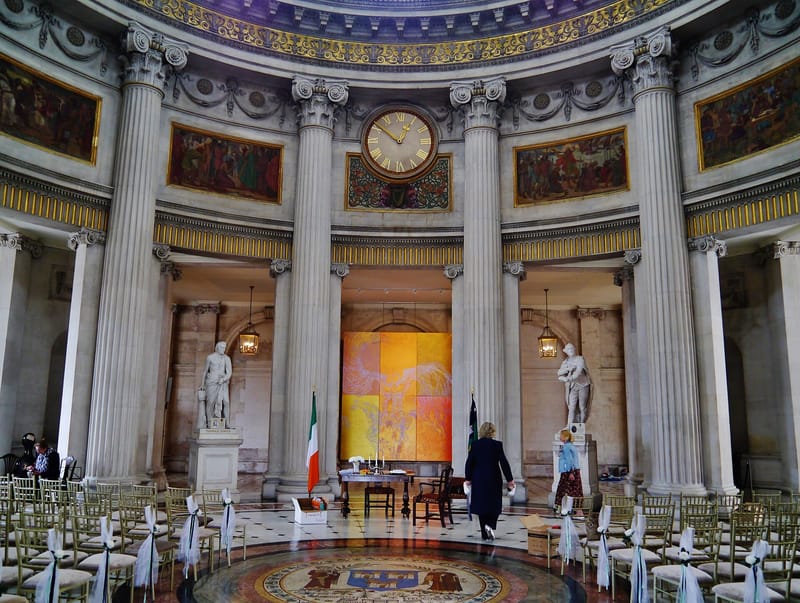
Photo: Zairon, CC BY 4.0, via Wikimedia Commons
The headline numbers
| Figure | Latest value | Source |
|---|---|---|
| Marriages in Ireland, 2025 | 19,898 | CSO Marriages 2025 |
| Same-sex marriages, 2025 | 624 (3.1% of all marriages) | CSO Marriages 2025 |
| Marriage rate | 3.6 per 1,000 population | CSO Marriages 2025 |
| Civil ceremonies | 33.4% of all marriages | CSO Marriages 2025 |
| Religious ceremonies, all denominations | 61% | CSO Marriages 2025 |
| Catholic ceremonies | 29.8% | CSO Marriages 2025 |
| Humanist ceremonies | 6.9% | CSO Marriages 2025 |
| Average age at marriage, opposite-sex couples | Groom 38.0, bride 36.1 | CSO Marriages 2025 |
| Busiest month | August, 12.9% of opposite-sex marriages | CSO Marriages 2025 |
| Average wedding budget, not including the honeymoon | €36,641 | weddingsonline, December 2025 |
| Average guest meal price | €107 per person | weddingsonline, December 2025 |
| Average number of guests | 141 | weddingsonline, December 2025 |
How many people marry in Ireland
| Year | All marriages | Same-sex marriages | Note |
|---|---|---|---|
| 2019 | 20,313 | 640 | The last full year before the pandemic |
| 2020 | 9,523 | 314 | Pandemic restrictions |
| 2021 | 17,217 | 500 | |
| 2022 | 23,173 | 618 | Postponed weddings caught up: the highest year in the series |
| 2023 | 21,159 | 646 | |
| 2024 | 20,348 | 668 | |
| 2025 | 19,898 | 624 | Down 450, or 2.2%, on 2024 |
Source: CSO. The marriage rate was 3.6 per 1,000 population in 2025, down from 3.8 in 2024 and 4.0 in 2023, against an estimated population of 5,458,607 in April 2025. Across the EU in 2024, Latvia had the highest rate at 5.5 per 1,000 and Italy the lowest at 2.9. About one in ten couples who married in Ireland in 2025 (10.3%) intended to live outside the State afterwards, most of them in England and Wales or Northern Ireland.
Types of ceremony
All 19,898 marriages registered in 2025. Bars are relative to the largest group. Source: CSO Marriages 2025.
Every marriage in Ireland is either a civil ceremony conducted by an HSE registrar, a religious ceremony, or a secular ceremony conducted by a solemniser from a body such as the Humanist Association. The CSO's 2025 count, for all marriages:
| Form of ceremony | Marriages in 2025 | Share |
|---|---|---|
| Civil marriage (HSE registrar) | 6,642 | 33.4% |
| Roman Catholic | 5,927 | 29.8% |
| Other religious denominations | 4,480 | 22.5% |
| Humanist Association | 1,382 | 6.9% |
| Spiritualist Union of Ireland | 1,263 | 6.3% |
| Church of Ireland | 204 | 1.0% |
Religious ceremonies of all kinds were 61% of marriages in 2025. The trend over four years, all marriages:
| Year | Religious, all denominations | Catholic | Civil | Humanist |
|---|---|---|---|---|
| 2022 | 64% | 40% | 26% | 9.3% |
| 2023 | 60% | 34.3% | 32.2% | 8.1% |
| 2024 | 59.5% | 31.6% | 33.1% | 7.4% |
| 2025 | 61% | 29.8% | 33.4% | 6.9% |
Catholic ceremonies have fallen from four in ten marriages in 2022 to three in ten, and civil ceremonies have overtaken them. "Other religious" has grown fastest, from 2,780 opposite-sex ceremonies in 2022 to 4,480 marriages in 2025. It covers every denomination outside the named ones, including the celebrant organisations registered as religious bodies that conduct personalised ceremonies at venues, which is why the religious share held steady while the Catholic share fell. Humanist ceremonies have eased back from their 2022 peak of 2,053.
Among same-sex couples in 2025, 54.2% had a civil ceremony, 11.7% a Humanist one, 5.6% a Spiritualist Union one and 28.5% another religious ceremony.
The weddingsonline surveys ask couples a different question, whether theirs is a church wedding, and get a different answer: 36% in January 2025 and 44% in January 2024. That is self-reported by couples still planning, so it isn't comparable with the CSO's count of registered marriages. Our guide to getting married in Ireland explains what each route involves and the three months' notice they all share.
Age at marriage
| Year | Average age of groom | Average age of bride |
|---|---|---|
| 1975 | 27.0 | 24.7 |
| 1985 | 27.4 | 25.3 |
| 2019 | 36.8 | 34.8 |
| 2020 | 37.8 | 35.7 |
| 2021 | 37.4 | 35.4 |
| 2022 | 37.4 | 35.4 |
| 2023 | 37.7 | 35.8 |
| 2024 | 37.7 | 35.9 |
| 2025 | 38.0 | 36.1 |
Opposite-sex marriages, CSO. In 2025, 36.2% of grooms and 39.3% of brides were aged 30 to 34, and 28.5% of grooms and 22.5% of brides were 40 or over. In same-sex marriages the average age was 40.6 for men and 38.1 for women.
The CSO averages include second and later marriages, which is why they sit above the ages couples give in the weddingsonline surveys: 35 for men and 33 for women in January 2025, and 33 and 32 in January 2024. The survey respondents are mostly planning a first wedding.
When Irish couples marry
From the CSO's 2025 figures for opposite-sex marriages:
- August was the most popular month, with 12.9% of marriages, as it has been every year since 2023. Almost one in four marriages (24.7%) took place in October, November and December. January was the least popular month, with 661 marriages (3.4%).
- Friday and Saturday accounted for 11,903 marriages, or 61.8%. Sunday was the least popular day, with 616 (3.2%).
- The busiest single dates were Friday 25 July (200 marriages) and Friday 1 August (197). In 2024 they were Friday 6 September and Friday 21 June, with 211 each.
- Among same-sex couples, August was also the busiest month (11.7%), and the busiest dates were Friday 12 September and Friday 21 March.
The weddingsonline survey of January 2025 shows the same pattern among couples planning a wedding: Friday and Saturday 71%, Thursday 16%, Sunday 4%; July to September 37% of weddings and April to June 33%. December is the most popular month to get engaged, at 23% of proposals in the January 2025 survey and 26% in January 2024.
What a Saturday in August costs compared with a Thursday in February is covered in our guide to wedding venue costs per head, and what the season does to the light and the day in the best season for your wedding.
What a wedding costs
Not including the honeymoon. Each figure is the average budget of the couples surveyed that winter. Source: weddingsonline surveys.
weddingsonline surveys Irish couples each winter. The headline budget excludes the honeymoon unless stated.
| Survey | Couples surveyed | Average budget | Guests | Meal per guest |
|---|---|---|---|---|
| December 2025 | over 1,000 | €36,641 (up 6.5%) | 141 | €107 |
| January 2025 | 641 | €34,392 (up 3.96%) | 154 | €93 |
| January 2024 | 1,023 | €33,083 | 144 | not asked |
| 2022 | over 1,900 | €29,812 (includes the honeymoon) | 153 | not asked |
The December 2025 survey put the average venue spend at €15,087, not including accommodation, which is simply 141 guests at €107 each. Guest lists are shrinking a little while the spend per guest rises. Our average wedding budgets guide walks through where the money goes.
What couples spend on each supplier
Average spend per category from the same surveys. "Not published" means the article reporting the December 2025 survey didn't list that category.
| Supplier | 2022 | January 2024 | January 2025 | December 2025 |
|---|---|---|---|---|
| Photographer | €1,779 | €2,094 | €2,108 | €2,276 |
| Videographer | €1,443 | €1,760 | €1,779 | €1,841 |
| Content creator | not asked | not asked | €1,270 | not published |
| Band | €2,232 | €2,492 | €2,673 | €2,833 |
| DJ | €526 | €694 | €711 | not published |
| Evening entertainment | €734 | €1,025 | €968 | €1,165 |
| Wedding dress | €1,725 | €2,042 | €2,054 | €2,002 |
| Suit (each) | €280 | €319 | €400 | not published |
| Engagement ring | €3,106 | €3,173 | €3,095 | not published |
| Wedding rings (both) | €1,511 | €1,468 | €1,672 | not published |
| Flowers | €747 | €921 | €1,071 | not published |
| Wedding cake | €350 | €454 | €480 | €436 |
| Wedding planner | €1,956 | €1,844 | €2,018 | €2,054 |
| Celebrant or officiant | €387 | €489 | €504 | not published |
| Wedding car | €518 | €618 | €625 | not published |
| Invitations | €248 | €291 | €298 | €327 |
| Honeymoon | €2,872 | €5,616 | €5,251 | not published |
For what those averages mean when you're getting quotes, see our guides to wedding photographer prices, wedding videographer prices, wedding bands and DJs and content creator costs. Our wedding budget planner starts from these averages and adds them up for your own guest numbers.
Budgets, borrowing and who pays
- January 2025 survey: 51% of couples went over budget, and 78% of those by more than €5,000. 34% took out a loan and 31% had help from parents. Couples chose suppliers on reviews and recommendations (51%) or because they were their favourite (28%); only 11% said price was the deciding factor.
- December 2025 survey: 54% of couples said reviews and recommendations were more important than price when choosing suppliers.
- January 2024 survey: 53% went over budget, 22% of them by more than €5,000. 37% took out a loan and 31% had help from parents.
- 2022 survey: 45% went over budget. 91% paid for the wedding themselves and 30% took out a loan.
Engagements
- January 2025 survey: 41% of couples were engaged for more than two years before the wedding, and only 7% for less than a year.
- January 2024 survey: 69% waited more than 18 months, and 9% less than a year.
Venues and counties
- Venue type: hotels 59%, country houses 20%, castles 13% (January 2025). A year earlier it was 65%, 18% and 11%, and in 2022 it was 70%, 15% and 10%, so the shift from hotels towards country houses and castles is steady.
- Most popular counties: Meath, Kildare, Cork and Dublin (January 2025). Meath, Cork, Kerry, Dublin, Cavan and Kildare (January 2024). Cork, Meath, Kildare, Kerry and Cavan (2022).
Our county guides cover Dublin, Kildare and Meath, Wicklow, Cork, Galway, Kerry and Northern Ireland.
Speeches, wedding parties and honeymoons
From the January 2025 survey:
- Speeches: 44% of couples had them before the meal, 23% during, 25% after, and 8% had none. Our guide to wedding speeches in Ireland covers the order and timing.
- Wedding party: eight people on average, including the couple.
- Accommodation: 63% of couples paid for their parents' rooms and 48% for the wedding party's; 22% paid for nobody's.
- Honeymoon: an average budget of €5,251. 90% went abroad, 70% of them a few months after the wedding, and 52% also took a short break in Ireland straight after. The most popular destinations were the USA, Spain, Italy, Greece, the Maldives and Mexico.
Reading the two sources together
The CSO and the surveys measure different things, and the gaps between them are informative rather than contradictory:
- The CSO counts every marriage registered in the State: first and later marriages, couples of every age, ceremonies of every size, and couples who married here but live elsewhere. It says nothing about money.
- The weddingsonline surveys are answered by couples who use the site, most of them planning a first wedding with a large guest list. They skew younger and towards bigger weddings, which is why the survey ages are lower than the CSO's and the church-wedding share differs from the CSO's ceremony count. They are the only regular published source on what Irish weddings cost, and the sample is large enough (641 to over 1,900 couples a year) to show real trends.
When a figure on this site is an estimate rather than one of these, we say so. The price bands in our cost guides, for example, are our reading of published rate cards and the quotes couples share with us, and they sit alongside the survey averages rather than replacing them.
Sources
- CSO, Marriages 2025, published 5 May 2026.
- CSO, Marriages 2024.
- CSO, Marriages 2023.
- CSO, Marriages 2022, which also gives the 2019 to 2021 totals.
- weddingsonline, The Real Cost of an Irish Wedding in 2026, survey of over 1,000 couples, December 2025.
- weddingsonline, Weddings Cost 3.96% More This Year, survey of 641 couples, January 2025.
- weddingsonline, Longer Engagements Are Popular, survey of 1,023 couples, January 2024.
- weddingsonline, How Much Does The Average Wedding in Ireland Cost?, survey of over 1,900 couples, 2022.
How this page is updated
The CSO publishes its Marriages release for each year the following spring (Marriages 2025 arrived on 5 May 2026), and weddingsonline publishes its survey in the first months of the year. We update this page after each one, keep the earlier years in the tables so the trend stays visible, and note the date at the top. If you spot a newer release before we do, we'd rather know.